Open any journaling forum, subreddit, or stationery meetup, and you will inevitably encounter two passionate, opposing schools of thought.
On one side stand the Chronological Purists. Their creed is simple: pick up your pen, write today's date at the top of the next empty page, and pour your thoughts onto the paper. When the day ends, draw a line; when the notebook fills up, shelve it and open a new volume.
On the other side stand the Topical Architects. Their notebooks are meticulous systems of tabbed dividers, dedicated sections, or multiple specialized volumes: one notebook for career goals, one for book notes, one for health tracking, and one for intimate personal reflections.

If you have ever tried either approach, you have likely run headfirst into their respective traps:
- The One-Notebook Chaos Trap (Chronological): You write an extraordinary, life-altering epiphany on Tuesday. Six months later, you remember having the thought, but it is buried beneath 180 pages of grocery lists, meeting scribbles, and weather observations. Locating it feels like panning for gold in an avalanche.
- The Multi-Notebook Burnout Trap (Topical): You buy five gorgeous notebooks or set up twelve rigid divider tabs. Two weeks later, you have written twenty pages in your work journal, three pages in your reading log, and zero pages in your mindfulness section. The guilt of empty, expensive paper paralyzes you, and carrying multiple notebooks everywhere turns your bag into a lead weight.
The central question is not which system is objectively superior. The real question is: how does your mind process information, and what is your journal actually trying to accomplish?
In this guide, we break down the mechanics, psychology, strengths, and failure modes of both systems. We provide paper-tested indexing techniques, present a head-to-head comparison matrix, detail three field-proven hybrid frameworks (including the Bullet Journal, the Two-Notebook method, and modern digital block setups), and provide a four-question diagnostic tool to help you build a sustainable journaling practice.
1. System 1: The Chronological System (Timeline-Based Journaling)
The chronological approach is the oldest, most natural way humans record their lives. From Marcus Aurelius's private meditations to Anne Frank's diary, entries flow sequentially from past to future, anchored entirely by the calendar.
The Core Philosophy: Life as an Unbroken River
In a pure timeline system, you do not segregate your life into artificial departments. Your career anxieties, your child's funny quote at breakfast, your lunch receipt, and your philosophical musings all share the same paper. Life happens chronologically, so your journal reflects that organic flow.
Why It Works: The Unmatched Benefits
- Zero Starting Friction: There is never a moment of hesitation before writing. You do not need to decide where an entry belongs. You simply open to the next available page, write the date, and start. For beginners or people struggling with consistency, lowering this barrier to entry is the single most important factor for success.
- Preserves Complete Emotional Context: When you look back at a note written during a difficult work crisis three years ago, seeing that you also noted a rainy afternoon, a bad cup of coffee, and a headache gives you the full human picture. Categorized notes often strip away this sensory and emotional richness.
- Embraces Serendipity and Spontaneity: You can scribble a sketch, test a fountain pen ink, list three books you heard about on a podcast, and draft an email response on the exact same spread. There is no fear of ruining the purity of a dedicated section.
Where It Breaks: The Practical Pain Points
- The Archival Black Hole: Because topics are scattered randomly across the timeline, retrieving thematic knowledge is agonizing. If you want to review all the business insights you gathered over the past year, you must manually flip through every single page.
- Fractured Continuity: If you are working on a creative project or learning a complex topic, your thoughts are split across dozens of disjointed entries separated by weeks of everyday trivia. Synthesizing these fragments into a coherent whole requires immense effort.
Paper Survival Techniques for Chronological Journalers
If you love the freedom of chronological writing but hate losing your best thoughts, experienced paper journalers rely on two classic adaptations:
1. The Front-Matter Master Index
Reserve the first 3 to 4 pages of your notebook before you write a single daily entry. Number every subsequent page in your journal (or buy pre-numbered notebooks such as Leuchtturm1917). Whenever you write a significant topical entry, turn back to your Index and log it:
- Books Read 2026: pp. 14, 28, 45, 82
- Project Alpha Brainstorm: pp. 18-21, 56
- Italy Trip Planning: pp. 63-68
2. Margin Edge Color-Coding
Using mild highlighter pens or small colored adhesive tabs, assign a subtle color to your primary life domains along the outer edge of your pages:
- Blue = Professional / Career
- Green = Financial & Budgeting
- Warm Coral = Personal / Emotional Musings
- Yellow = Books, Media & Quotes
When you close the notebook and look at the fore-edge, you can immediately spot where your thematic clusters lie without flipping through every sheet.
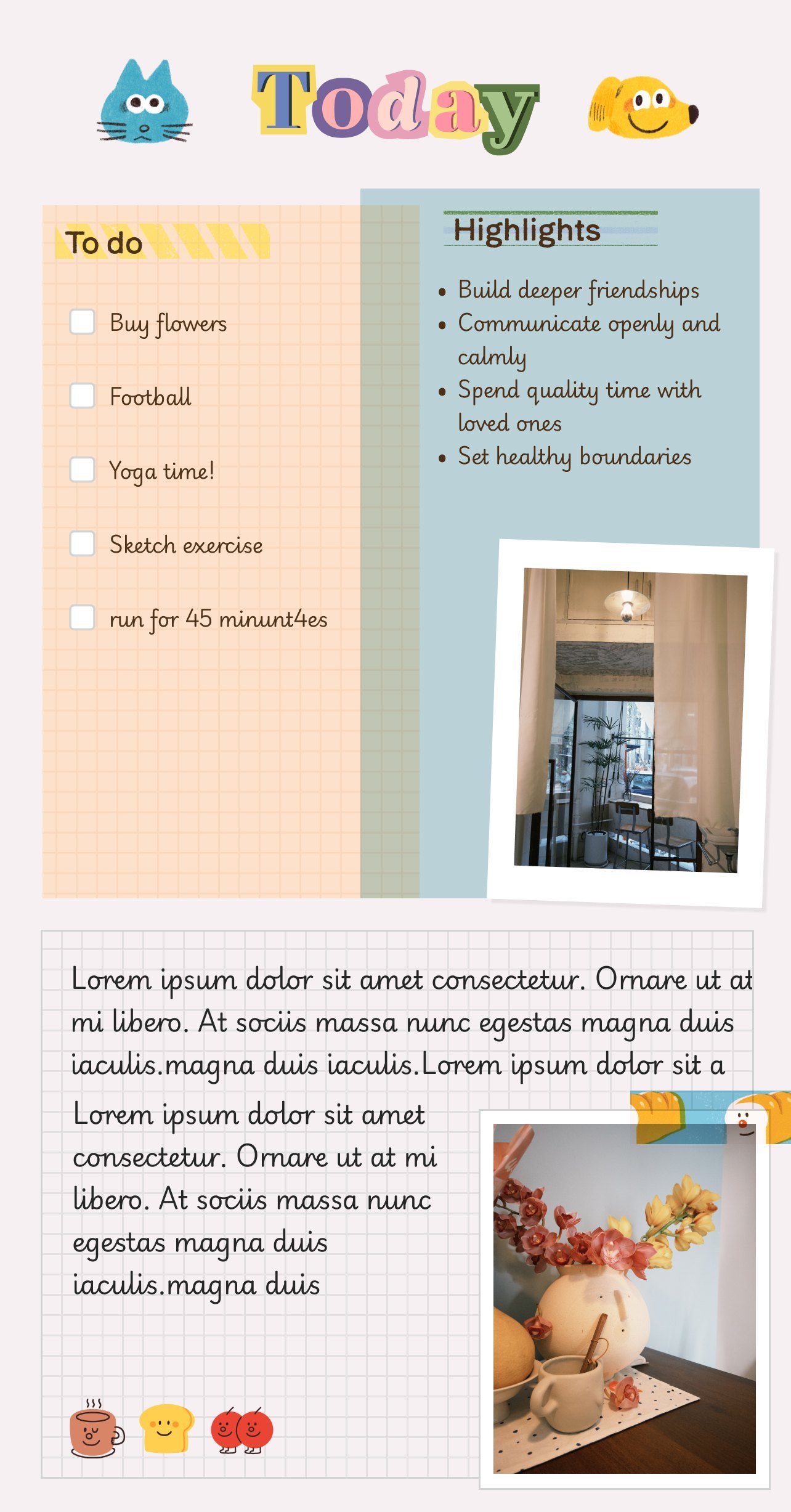

2. System 2: The Topical System (Category-Based Journaling)
The topical approach treats the notebook not as a diary, but as a modular personal encyclopedia or multi-subject binder.
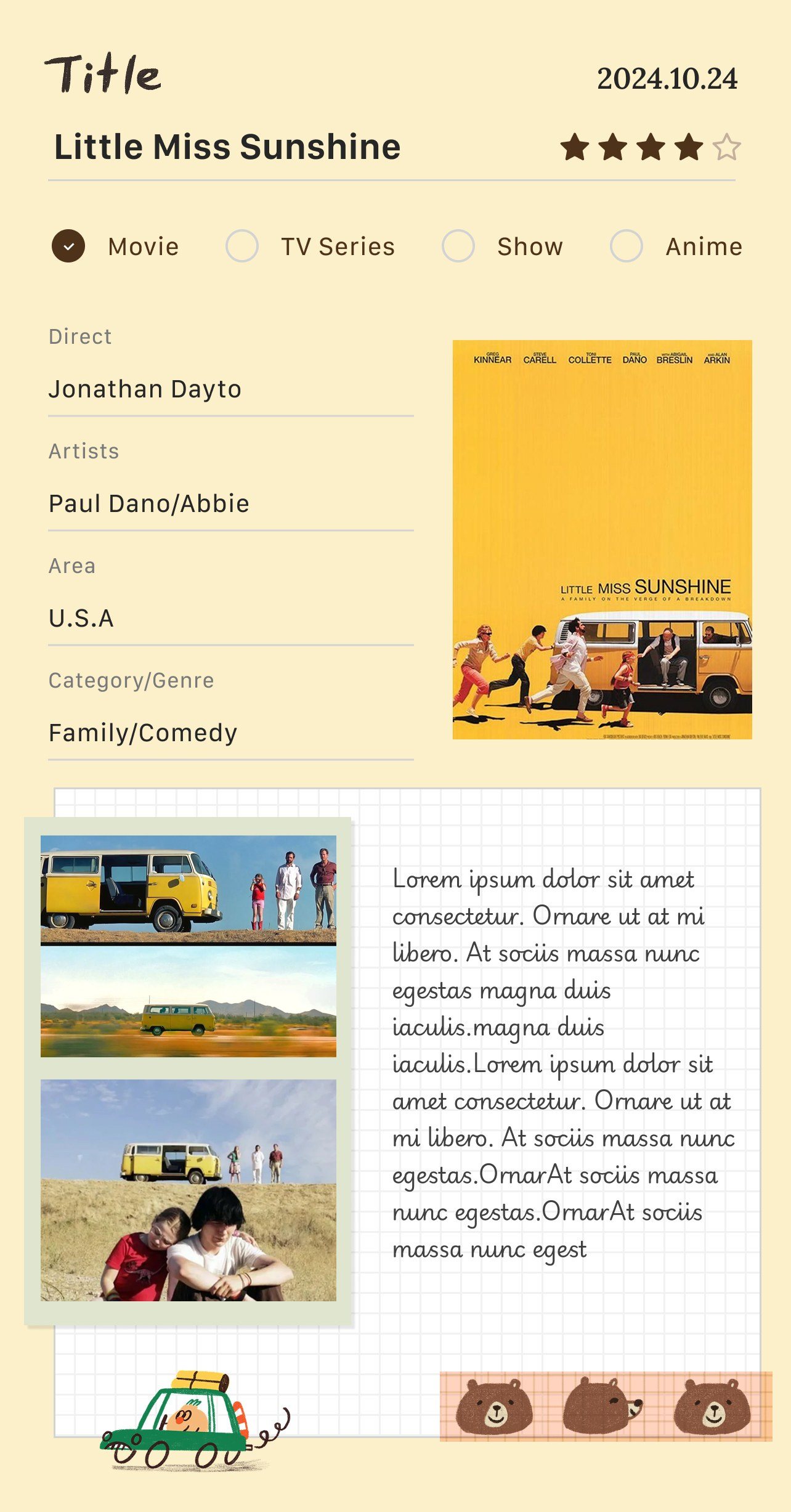
The Core Philosophy: Life as a Structured Architecture
In a topical system, information belongs with its kind. Your professional projects should not be mingled with your therapy reflections; your financial budgets should not sit next to a recipe for sourdough bread. You create dedicated territories where ideas can compound systematically over time.
Why It Works: The Unmatched Benefits
- Instant Thematic Retrieval: When you need to prepare for your annual performance review, you flip straight to your Career section. Every milestone, compliment, project outcome, and skill acquired over the past twelve months is consolidated in one place.
- Deep Knowledge Compounding: When you take reading notes or research a hobby in a dedicated space, each new entry builds directly upon the previous one. You can compare thoughts, track evolving perspectives, and spot patterns that are invisible in chronological chaos.
- Mental Compartmentalization: For people with high-stress jobs or compartmentalized brains, keeping sensitive personal journaling completely isolated from daily work schedules creates psychological safety.
Where It Breaks: The Practical Pain Points
- Severe Categorization Friction: Before you can write a single sentence, your brain must make a bureaucratic decision: Is this note about personal growth, work productivity, or creative writing? This micro-friction frequently causes people to abandon fleeting insights before the pen touches the paper.
- The "Uneven Notebook" Dilemma: In bound notebooks with pre-allocated sections or tabs, humans are terrible at predicting future volume. Your Work section runs out of pages in March, while your Fitness section remains 90 percent blank in December. This imbalance triggers deep perfectionist irritation.
- Loss of Organic Life Context: Reading a standalone list of project milestones gives you data, but it hides the lived experience. You lose the memory of how exhausted, inspired, or heartbroken you were while achieving those milestones.
Paper Survival Techniques for Topical Journalers
To make a topical physical system functional without tearing out pages in frustration, practitioners depend on specific hardware and strategies:
1. Ring-Bound Loose-Leaf Binders
Bound notebooks are the enemy of rigid topical organization. A six-ring binder (such as Filofax, Plotter, or standard A5/B6 loose-leaf systems) allows you to insert fresh blank leaves exactly where a topic is expanding, move completed projects to an archive, and remove unused pages effortlessly.
2. The Miscellaneous Catch-All Buffer Section
Never design a topical system where every square inch is categorized. Always include a generous tab marked Inbox or Raw Buffer. If an idea strikes and you are unsure where it belongs, write it in the buffer immediately. During your weekly review, you can decide whether to recopy it into a permanent topic or leave it as a transient scribble.

3. Head-to-Head Comparison: Chronological vs. Topical
To see how these two paradigms measure up across day-to-day realities, examine the core decision matrix below:
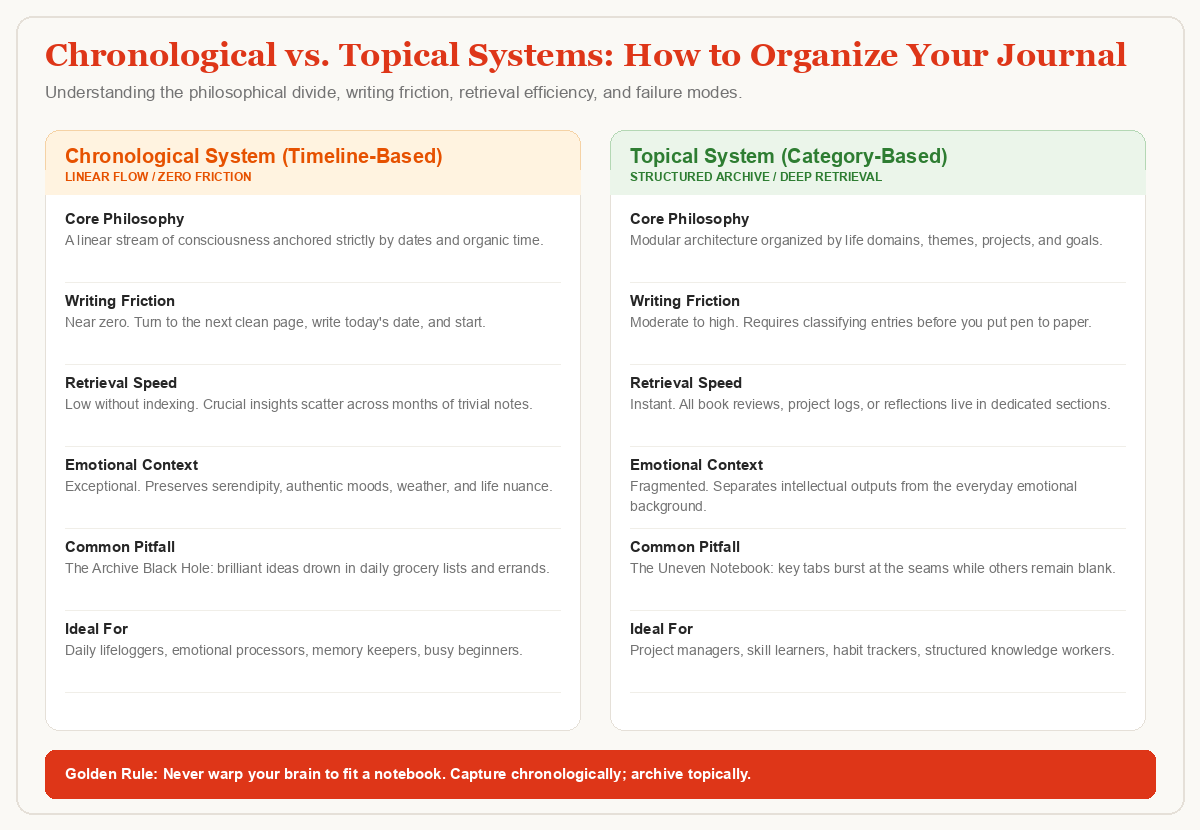
| Evaluation Dimension | Chronological System (Timeline) | Topical System (Category-Based) |
|---|---|---|
| Primary Organizing Anchor | Calendar date and sequential time | Subject domain, project, or theme |
| Barrier to Entry (Starting Friction) | Near Zero: Turn page, write date, record | Moderate to High: Must classify before writing |
| Retrieval Speed for Topics | Slow: Requires manual flipping or indexing | Instant: Everything on that theme is consolidated |
| Emotional Context Preservation | Exceptional: Captures mood, weather, and life | Fragmented: Detaches insights from daily context |
| Long-Term Knowledge Compounding | Weak: Ideas remain scattered across months | Exceptional: Systematic accumulation over years |
| Flexibility for Mixed Content | Total: Doodles, lists, and essays coexist | Rigid: Each section demands content conformance |
| Primary Failure Mode | The Archive Black Hole: Lost insights | The Uneven Notebook: Tab fatigue and blank pages |
| Maintenance Burden | Low: Write and move on | High: Ongoing filing, tab management, migration |
| Best-Fit User Profile | Lifeloggers, daily emotional writers, beginners | Project managers, researchers, deep hobbyists |
4. The 3 Master Hybrid Architectures
For most people, choosing strictly between 100 percent chronological logging and 100 percent topical separation is a false dichotomy. The most resilient journalers in the world use Hybrid Frameworks that capture the zero-friction speed of the timeline while preserving the organized power of topical archives.
Here are the three master architectures that bridge the divide:
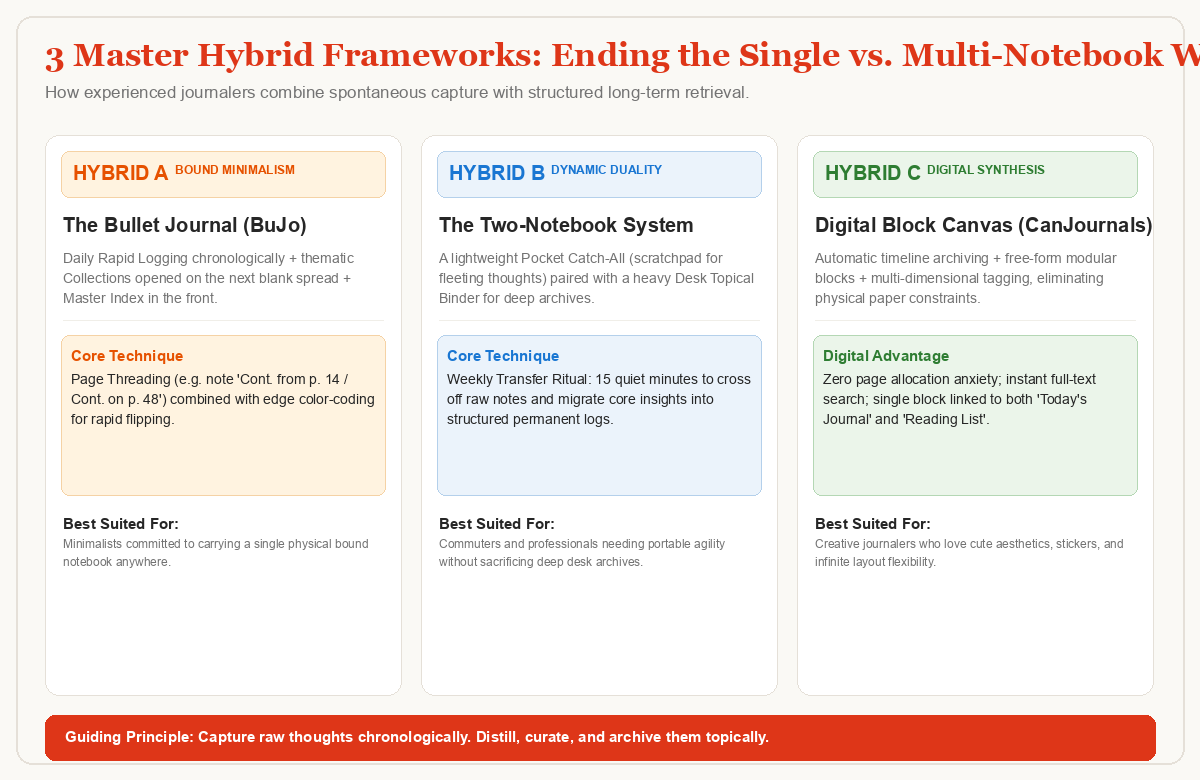
Hybrid A: The Bullet Journal System (BuJo)
Pioneered by designer Ryder Carroll, the Bullet Journal is arguably the most successful paper-based synthesis of chronological flow and topical collections ever invented.
How It Operates
- You keep everything inside a single, consecutively numbered bound notebook.
- Your daily life unfolds chronologically in the Daily Log. You rapid-log tasks, notes, and fleeting thoughts as they happen day by day.
- When you need to take deep notes on a book, plan a wedding, or outline a software project, you do not look for a special tab. You simply flip to the very next clean page, title it (e.g., Rome Trip Itinerary or Reading Notes: Atomic Habits), and write your collection there.
- Immediately turn back to your Master Index at the front of the notebook and record the topic and page number.
- When that collection needs more space later in the month, flip to the next available blank page and use Page Threading: at the bottom of the first page, write Cont. on p. 48, and at the top of page 48, write Cont. from p. 19.
Why It Succeeds
It completely eliminates the "Uneven Notebook" dilemma. You never run out of space in a pre-allocated section because space is allocated on-demand as you live your life.
Hybrid B: The Two-Notebook System (The Dynamic Duality)
If you dislike flipping back and forth to an index inside a single volume, the Two-Notebook system divides the labor physically between mobility and permanence.
The Hardware Setup
- Notebook 1: The Pocket Companion (The Capture Engine): A pocket-sized, slim notebook (such as a Field Notes, Traveler's Notebook Passport, or pocket grid memo pad) that lives in your jacket pocket or everyday carry bag. It is completely chronological. You use it for rapid capture: phone numbers, sudden epiphanies, grocery reminders, meeting timestamps, and emotional vents. It is deliberately messy, disposable, and fast.
- Notebook 2: The Desk Topical Archive (The Knowledge Engine): A larger, high-quality desk notebook or ring-bound binder (A5 or B5 size) that stays permanently at home or on your office desk. This volume is strictly topical, containing tabs for Core Life Goals, Deep Reading Reflections, Quarterly Reviews, and Major Projects.
The Weekly Transfer Ritual
Every Sunday afternoon or Friday evening, you spend 15 quiet minutes reviewing your Pocket Companion.
- You cross off transient to-do items and grocery notes.
- You identify the 2 or 3 genuine insights, book recommendations, or meaningful memories written that week.
- You transcribe or tape those distilled gems into their respective sections in your Desk Topical Archive.
This setup gives you the best of both worlds: zero friction while moving through the busy world, and elegant, structured order in your permanent personal library.
Hybrid C: Modern Digital Block Canvas (CanJournals & Digital Hybrids)
For generations, journalers were forced to accept the physical compromises of paper: ink is permanent, pages are finite, and words written on page 24 cannot magically appear on page 86.
Modern digital journaling platforms have rewritten these physical laws, solving the chronological-versus-topical conflict at the architectural level.

How Digital Blocks Solve the Paradox
In an app like CanJournals, you do not have to choose between a date and a topic:
- Automatic Timeline Anchoring: Every entry is automatically timestamped and placed along an organic chronological stream. You never have to manually date-stamp or worry about maintaining a calendar sequence.
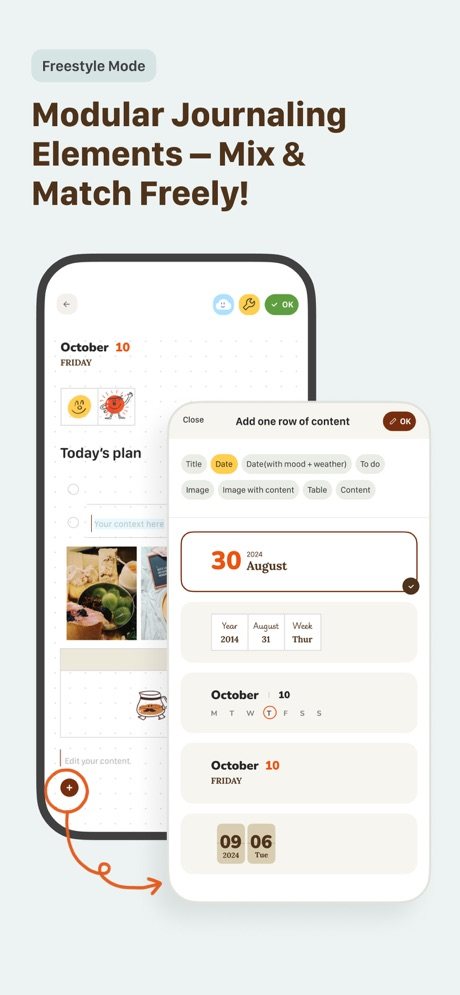
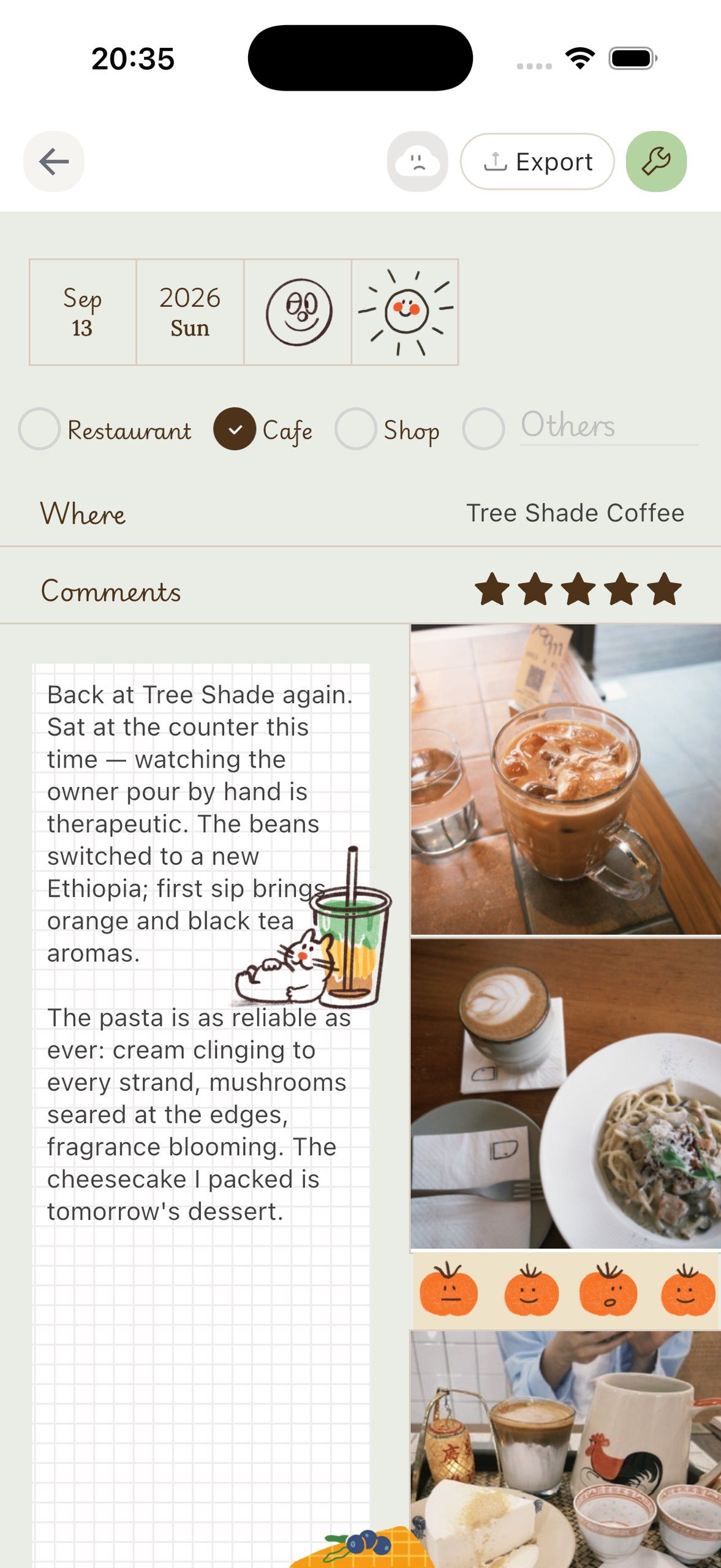
- Modular Block Freedom: Your journal page is not a rigid text document. It is composed of flexible, moveable visual blocks: a handwritten scribble, a photo collage, a mood stamp, a text block, or a decorative washi tape sticker.
- Multi-Dimensional Tagging and Aggregation: A single entry can live on today's timeline, yet simultaneously be tagged
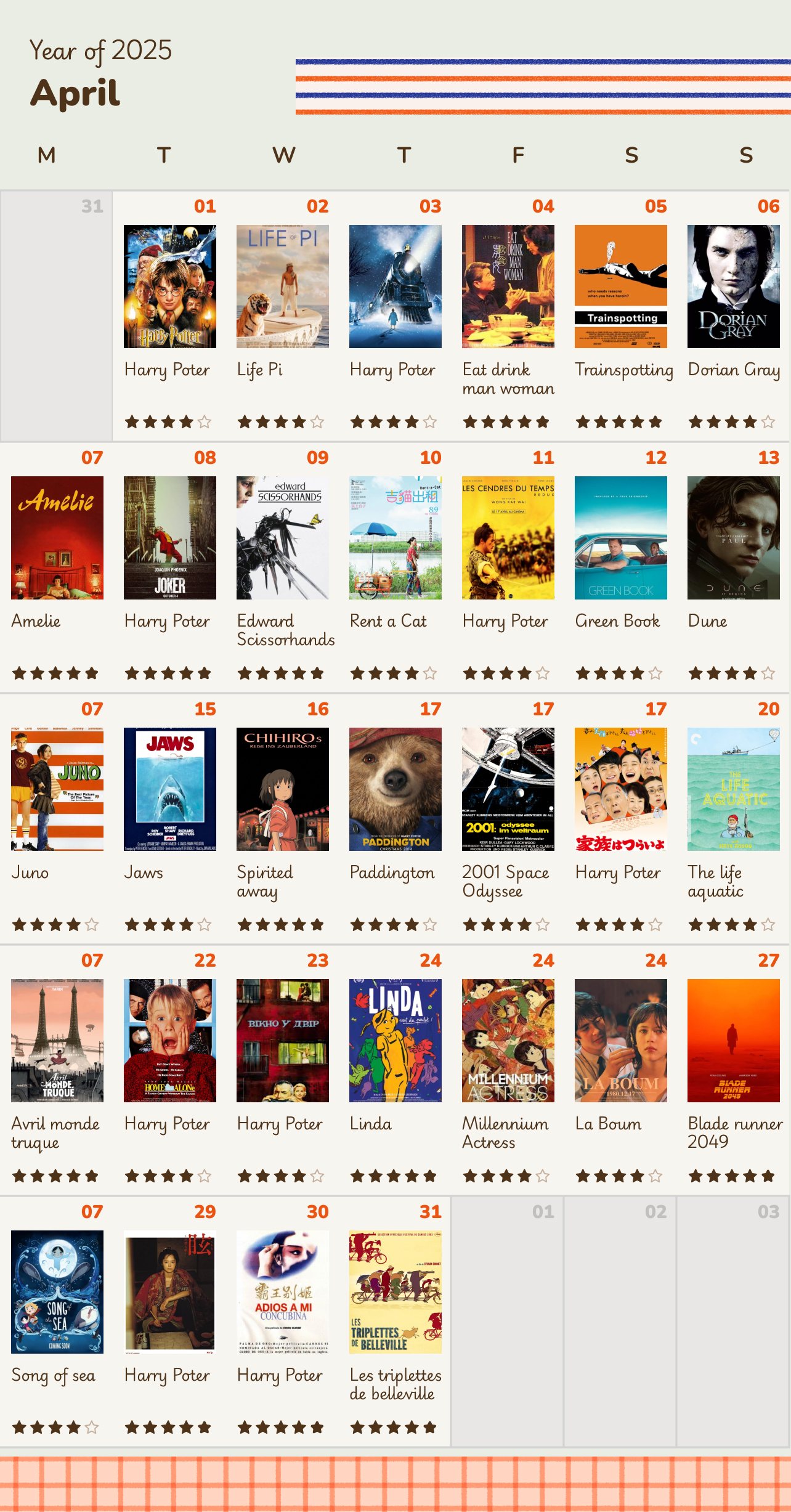
#BookReview,#Career, and#FilmLog. When you want to see your chronological life, you scroll your stream. When you want to see every movie you watched in 2026, you click the tag or filter, and every relevant block gathers instantly onto a single thematic canvas. - Zero Page Allocation Anxiety: There are no pre-printed page counts, no wasted blank leaves, and no running out of room midway through a creative burst.
Digital block architectures allow you to write with the zero-friction mindset of a chronological journaler, while retrieving with the instant precision of a master database architect.
5. The 4-Question Diagnostic Matrix: Find Your Match
Still uncertain which architecture suits your personality? Work through these four diagnostic questions to identify your ideal starting point:
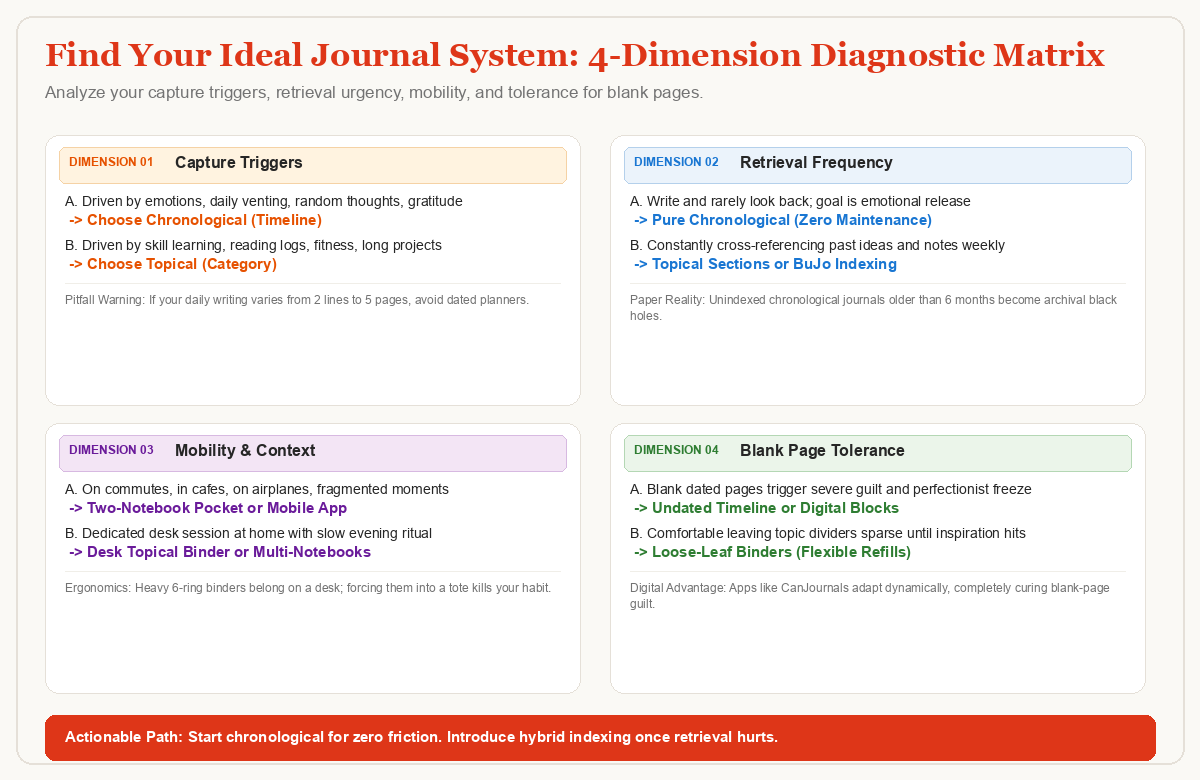
Dimension 1: What Primarily Triggers Your Urge to Write?
- Option A (Emotional & Experiential): You write when your head is buzzing, when you need to process anger, joy, anxiety, or describe an unexpected conversation you had over lunch.
👉 Verdict: Lean heavily toward a Chronological System. Forcing an emotional download into a categorized box kills authenticity. - Option B (Goal & Project Driven): You write to track metrics, advance specific projects, catalog media consumed, or analyze financial habits.
👉 Verdict: Lean toward a Topical System or Thematic Sections.
Dimension 2: How Frequently Do You Actively Search Past Entries?
- Option A (Rarely / Expressive Catharsis): For you, journaling is about the act of writing itself. Once an entry is written, you rarely re-read it. The value is emotional release and clarity in the moment.
👉 Verdict: Stick to a Pure Chronological Stream. Any time spent building elaborate indexes or tabs is wasted maintenance overhead. - Option B (Frequently / Reference & Compounding): You regularly revisit notes to write articles, prepare quarterly reviews, track recurring health symptoms, or check past decisions.
👉 Verdict: You require Topical Sections, a BuJo Index, or a Searchable Digital Platform.
Dimension 3: Where Does Your Writing Actually Take Place?
- Option A (On the Go / Fragmented): On commuter trains, in parked cars, during 5-minute work breaks, or while traveling.
👉 Verdict: Choose the Two-Notebook System (pocket notebook) or a Mobile Journaling App. Carrying heavy multi-tab binders will kill your habit within a fortnight. - Option B (Dedicated Sanctuary / Desk Ritual): You sit at your desk at night with a cup of tea, lighting a candle, with your favorite pens and washi tapes arrayed before you.
👉 Verdict: You have the ideal environment for a Desk Topical Binder or a Master BuJo.
Dimension 4: How Do Blank, Unfilled Pages Make You Feel?
- Option A (Paralyzing Guilt): Seeing pre-printed calendar dates or empty category tabs that you skipped makes you feel like an undisciplined failure. You would rather abandon the entire notebook than look at a stretch of blank pages.
👉 Verdict: Avoid dated planners and fixed topical notebooks completely. Use an Undated Chronological Notebook or a Dynamic Digital Canvas. - Option B (Total Indifference): Blank dividers do not bother you in the slightest. You are happy to leave a tab empty until you have something meaningful to say.
👉 Verdict: You have the psychological tolerance for a Loose-Leaf Topical Binder.
6. How to Transition: A Frictionless Migration Guide
If your current journal feels like an unmanageable mess, please resist the urge to buy three new notebooks, rip out pages, or throw your current book into the recycling bin.
The secret to sustainable notebook organization is evolutionary adjustment, not revolutionary overhaul.
Step 1: Declare an "Organizational Amnesty"
Open your current notebook to the very next clean spread. Do not attempt to retrospectively index 200 pages of past chaotic scribbles. Draw a horizontal line across the top, write today's date, and write: Fresh Organization Starts Here. Everything prior to this line remains a historical time-capsule of your previous season.
Step 2: Establish a 2-Page "Rolling Index" Immediately
If you are using a bound paper journal, turn to the final two pages of your current notebook. Label them Index. From today forward, whenever you write a list, a reading log, or a high-value reflection, jot down the page number on those back pages. You have instantly gained 80 percent of the power of a topical system without changing your daily writing habit.
Step 3: Implement the 15-Minute Weekly Transfer
If you want to adopt the Two-Notebook system or transition to a digital hybrid, do not do it in the middle of a frantic Tuesday morning. Set a recurring reminder for Sunday at 5:00 PM. Sit down with your quick daily notes, pick out the two items that still feel meaningful after 48 hours, and copy them into your permanent thematic collection.
Step 4: Let Your System Expand Organically
Never create a category or buy a divider tab for a topic you hope to care about in the future. Wait until you have organically accumulated at least five distinct entries on a subject before granting it a dedicated section. Let your life dictate your journal structure, never the other way around.
Summary Checklist: Your Journal Organization Blueprint
To recap, keep these foundational principles close at hand whenever you evaluate your setup:
- Capture is about speed; archiving is about retrieval. Never introduce categorization friction at the moment of initial capture.
- If you write for emotional release, choose the Chronological Timeline. It offers zero friction, authentic voice, and complete contextual memory.
- If you write to manage projects and compound knowledge, choose Topical Sections. Use loose-leaf binders so your page allocations remain fluid.
- When in doubt, choose a Hybrid. The Bullet Journal gives you single-volume indexing, the Two-Notebook system gives you portable speed plus desk tranquility, and digital block apps like CanJournals give you instant multi-dimensional views with zero physical constraints.
Pick up your pen or open your app today. Write what happened, write how you felt, and let the system serve your life, not your ego.

7. Frequently Asked Questions (FAQ)
What is the fundamental difference between chronological and topical journaling?
Answer: A chronological journal organizes entries strictly by date and time, offering zero initial capture friction and preserving emotional context. A topical journal groups entries by theme or project, which makes long-term retrieval and thematic knowledge compounding much easier at the expense of upfront filing friction.
Can I use both chronological daily entries and topical tracking in the same journal?
Answer: Yes. You can use the Bullet Journal method with an index in the front, the Two-Notebook system with a pocket chronological book and a desk topical binder, or digital block apps like CanJournals that allow single blocks to be tagged and viewed across both chronological timelines and topical collections.
What should I do if an entry fits into more than one topic?
Answer: Avoid rigid category dividers in physical journals, which often trigger categorization paralysis. Instead, record the entry chronologically and write page-threading references at the bottom. In digital systems like CanJournals, you can tag a single note or block with multiple categories simultaneously without duplicating text.
How do I fix a disorganized journal without starting over from scratch?
Answer: Declare an organizational amnesty. Do not waste energy trying to back-index or recopy past messy entries. Draw a clean dividing line on your next blank page, label it 'Fresh Organization Starts Here', create a two-page rolling index at the back of your notebook, and let your new structure evolve naturally.