You sit at your desk on Sunday evening with a fresh notebook, a clean planner spread, and a knot in your stomach.
On the left page sits last week's agenda: thirty-two ambitious check-boxes, fourteen of which remain stubbornly unchecked. On the right page sits next week's empty grid, demanding that you schedule forty new tasks across Monday through Friday.
If this ritual feels less like self-care and more like an interrogation by an angry boss, you are not alone.

Most people abandon weekly reflection within three weeks because they make a fundamental mistake: they confuse Weekly Planning with Weekly Review.
When you rush straight into scheduling meetings, projecting goals, and listing tasks without first processing the emotional and cognitive baggage of the past seven days, you carry last week's unresolved stress directly into next week's calendar.
This comprehensive guide shows you how to establish a nourishing, 10-to-15 minute weekly review practice. Grounded in established reflective inquiry and productivity frameworks, we break down why planning and reviewing require opposite mental postures, provide a field-tested 10-prompt questionnaire organized across four intuitive phases, offer a minimalist 3-2-1 emergency fallback, and walk through a complete, candidly filled demonstration week.
1. The Critical Distinction: Weekly Planning vs. Weekly Review
Before picking up your pen, it is essential to understand why planning and reviewing cannot happen at the same time. They engage two completely different modes of human cognition.
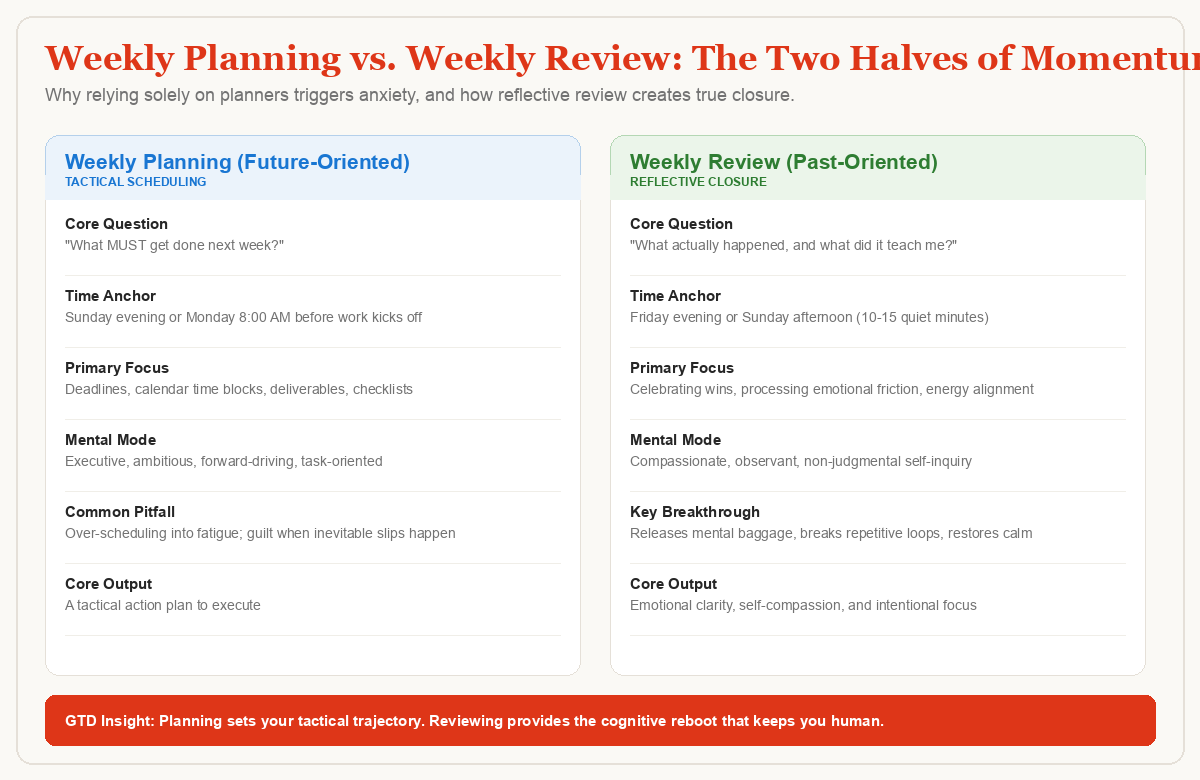
Weekly Planning: Facing Forward (Tactical Structuring)
- Primary Question: "What MUST get done next week?"
- Direction: Future-facing, prospective, logistical.
- Mental Mode: Executive control, ambition, task breakdown, boundary management.
- Tools: Calendars, time-blocking grids, project roadmaps, kanban boards.
- The Inherent Hazard: When practiced in isolation, planning easily turns into an unrealistic fantasy wish-list. You overcommit your future energy based on idealized assumptions, setting yourself up for exhaustion and chronic self-reproach when real-life interruptions inevitably arise.
Weekly Review: Facing Inward & Backward (Reflective Closure)
- Primary Question: "What actually happened, and what did it teach me?"
- Direction: Past-facing, introspective, restorative.
- Mental Mode: Compassionate observer, curiosity, pattern recognition, emotional decluttering.
- Tools: Journal pages, prompt questions, open unlined paper, mindful audio.
- The Core Breakthrough: Reviewing acknowledges reality. It provides cognitive and emotional closure, neutralizes rumination, and reveals recurring behavioral traps before you commit to new responsibilities.
The GTD Heritage: Clearing Open Loops
In his foundational methodology Getting Things Done: The Art of Stress-Free Productivity, veteran organizational consultant David Allen identified the weekly review as the single linchpin of mental clarity.
Allen observed that the human mind is designed for having ideas, not holding them. When meetings, unresolved arguments, delayed tasks, and half-finished commitments float around in your working memory, your subconscious mind treats every single one of them as an active emergency. Cognitive psychologists refer to this as the Zeigarnik Effect—the tendency of the brain to preserve intrusive thoughts about unfinished tasks until they are consciously acknowledged and slotted into a trusted holding system.
A proper weekly review does not demand that you finish every lingering project before Monday. Instead, it creates a deliberate container where you look your past week in the eye, celebrate what went right, release what did not, extract the core lesson, and close the file.
Only after completing this retrospective reset can your subsequent weekly planning be realistic, grounded, and calm.
2. The 4-Phase Weekly Review Framework: 10 Reflective Prompts
A blank page can feel overwhelming when your brain is tired at the end of the week. Rigid checklists, on the other hand, feel sterile.
The sweet spot is a structured prompt sequence. Rather than asking generic questions like "How was your week?", these ten prompts guide your awareness through four sequential phases: anchoring your wins, discharging emotional tension, decoding personal patterns, and crystallizing future focus.
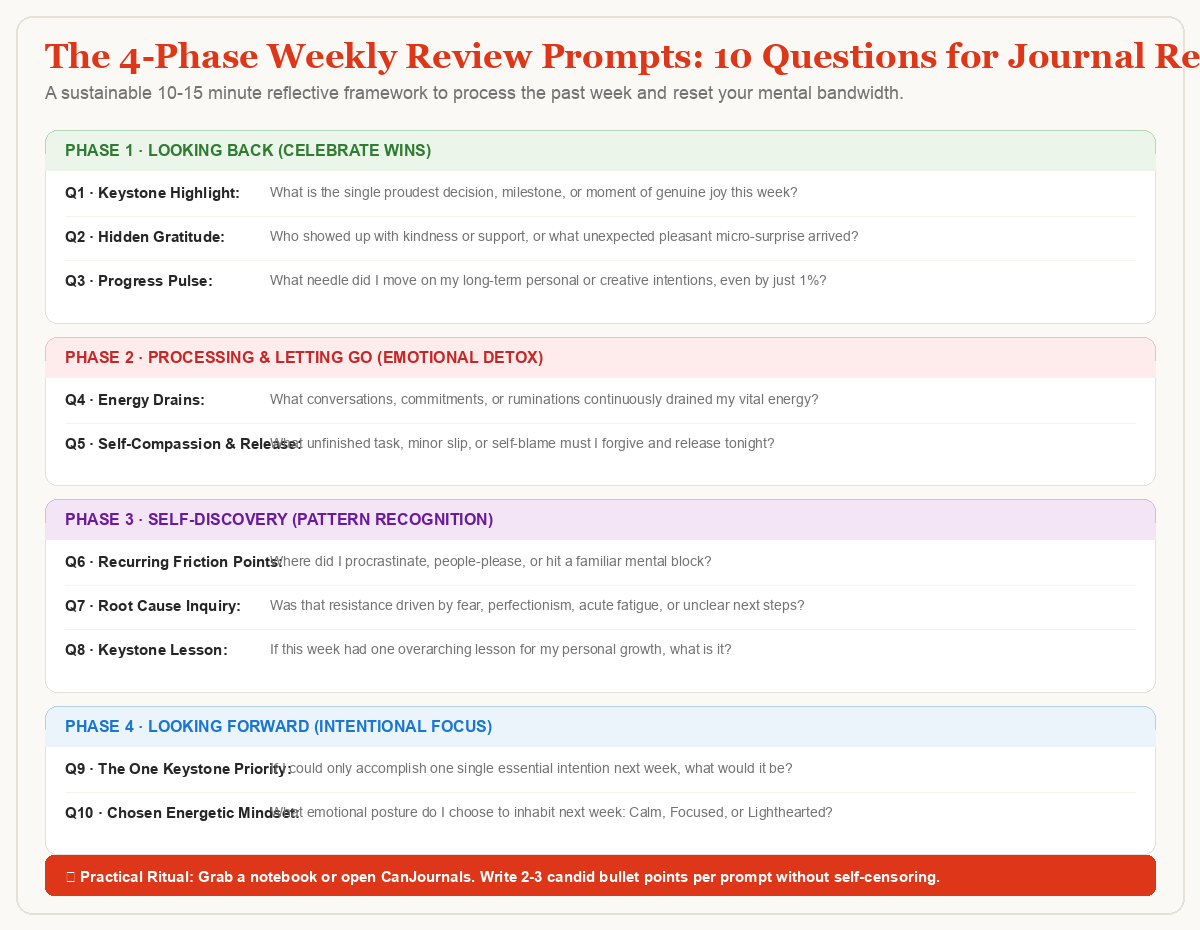
Phase 1: Looking Back (Anchor Momentum & Wins)
Human attention suffers from an evolutionary negativity bias: we naturally remember one awkward comment or missed deadline far more vividly than twenty quiet accomplishments. Phase 1 deliberately recalibrates your perspective before examining problems.
Prompt 1 (Keystone Highlight)
"What was the single decision, milestone, or micro-moment I am proudest of this week?"
How to answer: Resist the urge to only write down massive professional trophies. A proud moment can be boundary-setting (saying no to an unpaid weekend obligation), creative courage (hitting publish on a personal essay), or restorative care (turning off your screen at 9:30 PM to sleep).
Prompt 2 (Hidden Gratitude & Support)
"Who showed up for me with kindness or patience, or what small, unexpected delight brought genuine warmth?"
How to answer: Focus on tactile, concrete memories. A coworker who volunteered to take over a tedious spreadsheet; a stranger holding the subway doors; steam rising from a cinnamon bun during a rainy commute. Gratitude practice works best when tied to sensory specificity.
Prompt 3 (Progress Pulse)
"What needle did I move forward on my long-term personal values or creative dreams, even by just 1%?"
How to answer: When life feels like an endless treadmill of urgent firefighting, measuring 1% moves keeps your soul intact. Did you read ten pages of your book? Did you research flights for a future vacation? Did you practice five minutes of deep breathing? Acknowledge it here.
Phase 2: Processing & Letting Go (Emotional Detox)
Self-improvement advice often preaches ruthless optimization while ignoring human emotional residue. If you experienced frustration, betrayal, anxiety, or guilt this week, stuffing those feelings down only guarantees they will erupt as fatigue or irritability on Tuesday morning.
Prompt 4 (Energy Drains & Leaks)
"What conversations, obligations, or circular thoughts continuously drained my vital energy?"
How to answer: Identify the specific vampires of your time and attention. Was it a recurring committee meeting with no agenda? Doom-scrolling news threads during lunch? Obsessing over an ambiguous text message? Naming the leak is the mandatory first step to patching it.
Prompt 5 (Self-Compassion & Release)
"What unfinished assignment, minor blunder, or harsh self-judgment must I forgive and release tonight?"
How to answer: Borrow a principle from Cognitive Behavioral Therapy (CBT): distinguish between what was inside your sphere of control and what was not. If you caught a cold, your child had a fever, or a client changed specifications on Friday afternoon, beating yourself up for missing a self-imposed deadline is irrational cruelty. Write down your forgiveness explicitly: "I release the guilt of not finishing X. I did the best I could with the energy I had."
Phase 3: Self-Discovery (Pattern Recognition & Blind Spots)
Without reflection, experience merely produces repetition. Phase 3 transforms painful hiccups into durable wisdom by examining the underlying causes behind your friction points.
Prompt 6 (Recurring Friction Points)
"Where did I procrastinate, people-please, or run headfirst into a familiar mental wall?"
How to answer: Look for patterns that feel suspiciously familiar. Did you agree to help someone else finish their work before completing your own? Did you delay starting an important project draft until three hours before the deadline? Observe these behaviors like an anthropologist studying a subject—with neutral curiosity rather than shame.
Prompt 7 (Root Cause Inquiry)
"Was my hesitation fueled by fear of failure, perfectionism, chronic physical exhaustion, or unclear next steps?"
How to answer: Procrastination is rarely a character defect or laziness; it is an emotional regulation problem. When you resist a task, ask why. If you do not know the next physical action (e.g., you do not have the client's login credentials), the problem is informational. If you are terrified your work will look amateurish, the problem is perfectionism. If you cannot keep your eyes open, the problem is biological. Diagnosing the root cause dictates the cure.
Prompt 8 (Keystone Lesson)
"If this entire week had one overarching lesson for my personal growth, what is it?"
How to answer: Distill your insight into a single memorable aphorism you can carry into the future. Examples: "Silence in a meeting is better than committing to a timeline I cannot meet," or "A messy first draft written on Tuesday is ten times better than an imaginary masterpiece delayed until Friday."
Phase 4: Looking Forward (Intentional Focus)
Now—and only now—are you mentally equipped to look toward the horizon. Having acknowledged your achievements, emptied your emotional trash, and extracted your lessons, you can establish clear guardrails for the upcoming week.
Prompt 9 (The One Keystone Priority)
"If I could only accomplish one single essential intention next week, what is the linchpin that would make everything else easier or irrelevant?"
How to answer: Inspired by Gary Keller's The ONE Thing principle, strip away the delusion that ten things can all be top priority. Pick the one non-negotiable anchor project. If that single deliverable gets completed, your week is an objective victory, regardless of secondary clutter.
Prompt 10 (Chosen Energetic Mindset)
"What primary emotional posture or quality do I choose to cultivate across the coming days: Calm, Focused, Playful, or Resilient?"
How to answer: Productivity is not just what you check off; it is how your nervous system experiences the hours. Choosing an anchor word (such as Unhurried, Clear, or Patient) serves as a psychological compass when daily crises threaten to throw you off balance.
3. The Minimalist Fallbacks: The 3-2-1 & Start/Stop/Continue Methods
Let us be completely honest about real life: there will be Sundays where you return home from traveling at 10:15 PM, your head is pounding, your laundry is piled high, and the idea of answering ten reflective journal prompts feels impossible.
On those nights, do not skip your review entirely. Skipping breaks your habit loop and invites lingering dread into Monday morning. Instead, deploy one of two streamlined fallback protocols.
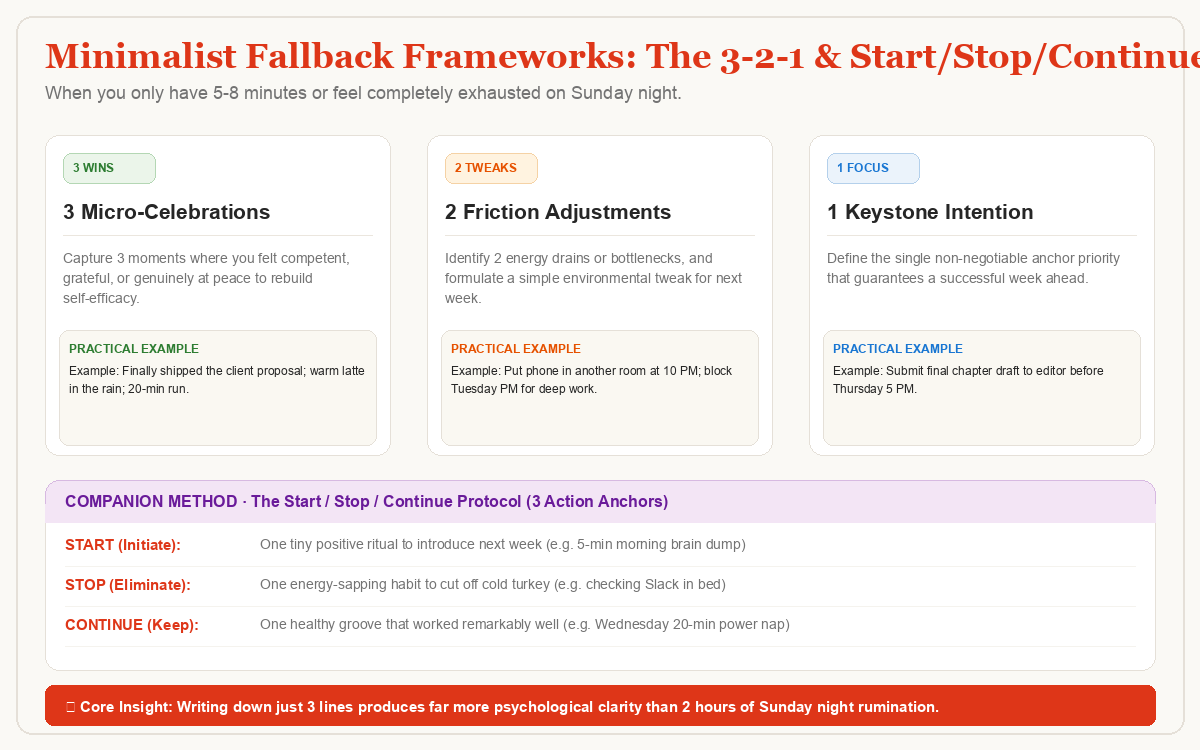
The 3-2-1 Emergency Protocol (Under 5 Minutes)
Grab a scrap of paper, a sticky note, or open a fresh card in your journal app. Write down exactly six lines:
- 3 Wins: Three micro-moments where you felt competent, grateful, or at peace.
- 2 Adjustments: Two friction points or bottlenecks you will actively tweak or say no to next week.
- 1 Keystone Focus: The single anchor commitment that matters above all else.
The Start / Stop / Continue Framework
If you prefer a behavioral, action-oriented recap, write three quick sentences:
- START: One tiny, supportive ritual to initiate (e.g., "Start putting my phone on the entryway table at 9:30 PM.")
- STOP: One energy-sapping pattern to terminate immediately (e.g., "Stop answering work emails on my phone while waiting in grocery checkout lines.")
- CONTINUE: One healthy momentum habit that worked well this week (e.g., "Continue taking a 15-minute walk around the block immediately after finishing lunch.")
Writing down three lines produces infinitely more cognitive clarity than spending two hours tossing in bed while mentally reviewing your worries.
4. Complete Demonstration Case Study: A Realistic Week Filled Out
(Demonstration Case Study: The following journal spread represents a real-world, authentic reflection written by an office professional and creative writer on a Sunday afternoon. Notice the sensory textures, candid vulnerability, and practical problem-solving.)
Weekly Review: Week 42 (October 19, 2026)
Phase 1: Looking Back
- Q1 · Keystone Highlight: Shipped the complete Q3 customer analytics dashboard on Thursday morning after putting it off for twelve days. When the engineering lead messaged back saying "This is the cleanest breakdown we have seen all quarter," a physical wave of relief washed over my shoulders.
- Q2 · Hidden Gratitude: On Wednesday morning, my commuter train broke down in heavy rain and my umbrella inverted, soaking my coat. But when I ducked into the little bakery alley near the north exit, the barista noticed I was shivering and handed me an extra-hot cinnamon oat milk latte with a tiny smiley face drawn on the lid. That simple gesture turned a wretched morning into a quiet blessing.
- Q3 · Progress Pulse: Guarded thirty minutes on Tuesday and Thursday morning to work on my novel draft before opening work chat. Added 850 words to Chapter 4. The story is moving again.
Phase 2: Processing & Letting Go
- Q4 · Energy Drains: That sudden 4:30 PM emergency message in the cross-team group chat on Friday regarding scope changes. I let myself spiral into anticipatory panic for two hours, checking my notification badge every ten minutes until dinner, only to find out the client did not even need an answer until Tuesday.
- Q5 · Self-Compassion & Release: I did not finish updating my personal expense tracker for October, and I skipped my Saturday morning gym session because of sheer fatigue. I forgive myself. My body needed nine hours of restorative sleep far more than it needed a leg workout. I release the phantom guilt.
Phase 3: Self-Discovery
- Q6 · Recurring Friction Points: Every time I had to write complex documentation this week, I opened four different social media tabs and cleaned my desktop folders first. Classic avoidance behavior.
- Q7 · Root Cause Inquiry: My hesitation was not laziness; it was acute intimidation. I felt like the document had to be comprehensive and authoritative from the very first paragraph. As soon as I lowered the bar and promised myself I would write a "deliberately terrible bullet draft for fifteen minutes," the resistance dissolved.
- Q8 · Keystone Lesson: "Urgent notifications from other people's emergencies do not require an immediate panic response from my nervous system."
Phase 4: Looking Forward
- Q9 · The One Keystone Priority: Finalize and submit the 2027 software vendor migration proposal by Thursday 2:00 PM so our budget approval can clear before the end of the month.
- Q10 · Chosen Energetic Mindset: Unhurried Clarity. Whenever someone drops an unexpected request into my day, I will take one slow, full breath before responding.
5. Designing Your 15-Minute Review Ritual (Paper or Digital)
A ritual is only as reliable as the friction surrounding it. If your review requires digging through six apps, hunting for a missing pen, or sitting in a noisy, distracting environment, you will abandon it the moment your schedule gets tight.
Step 1: Establish an Unshakable Time Anchor
Anchor your review to an existing weekend habit rather than relying on abstract motivation:
- Option A (The Workday Closeout): Friday at 4:30 PM. Review your professional week before logging off, allowing you to walk into the weekend completely unburdened by work thoughts.
- Option B (The Sunday Afternoon Tea): Sunday at 4:00 PM with a fresh pot of herbal tea. You still have the entire evening ahead of you for leisure, eliminating the late-night panic of the "Sunday Scaries."
Step 2: Assemble Sensory Cues
Light a specific scented candle, put on an ambient instrumental playlist, and silence all push notifications. These environmental cues signal to your nervous system that you are transitioning from "reactive worker" to "reflective author of your life."
Step 3: Paper Notebooks vs. Digital Block Journaling
Both mediums work beautifully; the choice depends on your personal lifestyle:
- If you choose Paper: Use an A5 dot-grid notebook or a standard Traveler's Notebook. Draw a simple four-quadrant box across a double-page spread, label each quadrant with Phase 1 through Phase 4, and let your handwriting flow freely.
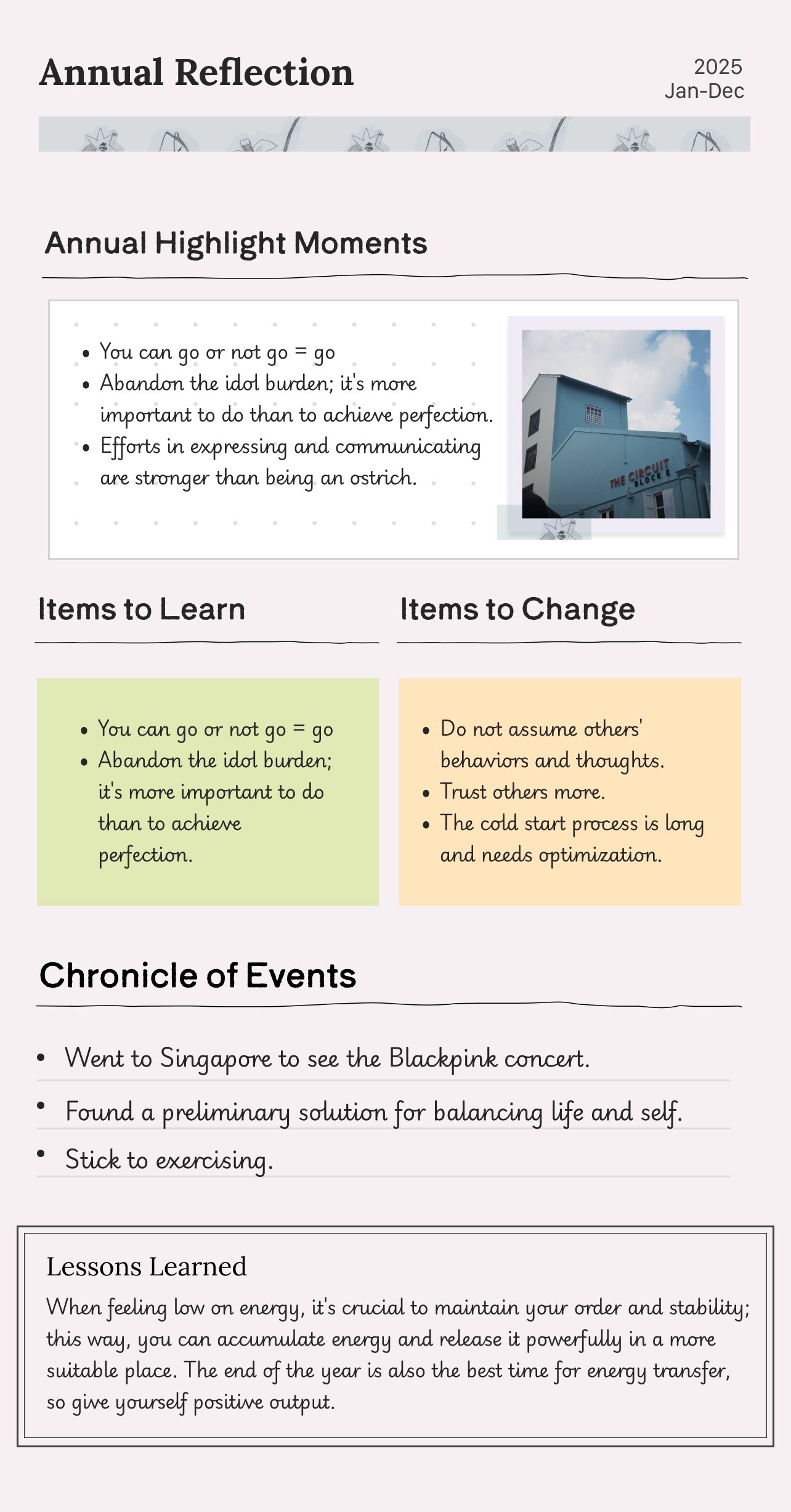
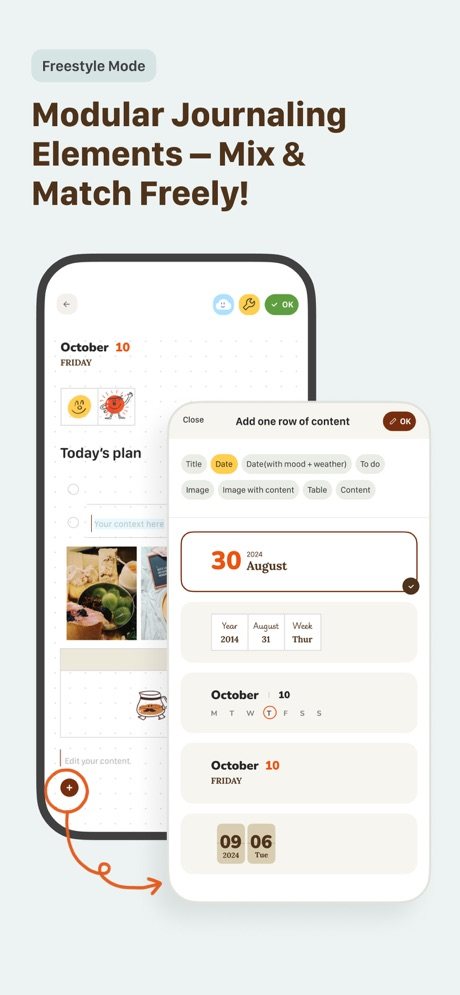
- If you choose Digital (CanJournals): If you prefer keeping your reflections searchable, backup-protected, and visually inspiring on iPad, iPhone, or Mac, CanJournals provides block-based journaling tailored for this workflow:
- Modular Prompts as Blocks: Keep your ten prompts saved as a reusable weekly template block. Fill in bullet points or collapse sections as you complete them.
- Mood & Energy Tagging: Tap pre-built mood icons and color-coded energy meters to visualize emotional trends across months without tedious data entry.
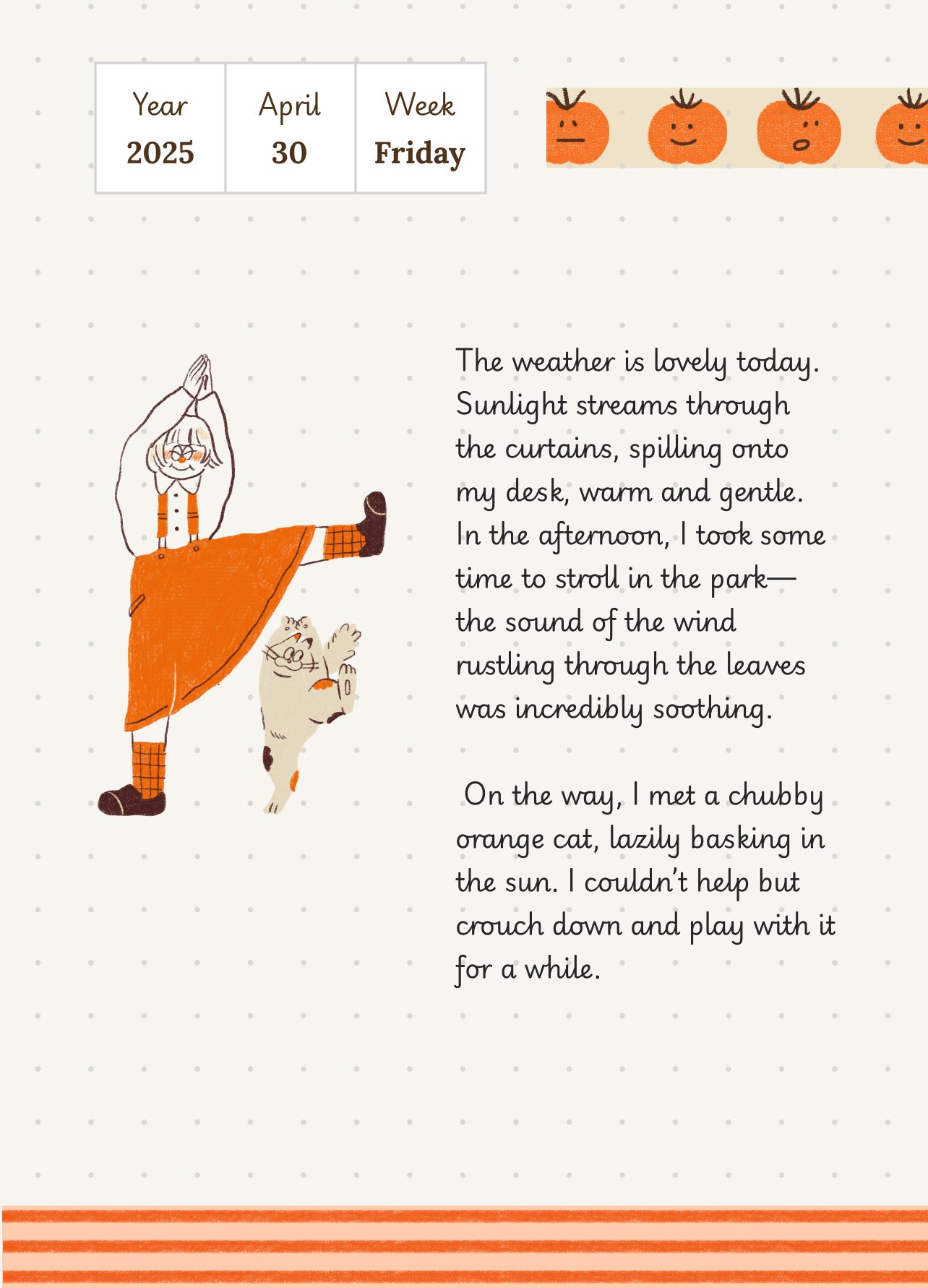
- Apple Pencil Handwriting & Aesthetic Embellishments: Combine fluent digital handwriting with vintage washi tape, stamp stickers, and photos taken during the week (like that rainy-day cinnamon latte).
- Zero Cloud Leakage: All reflections remain locally stored on your device with optional biometric passcode locking, ensuring your candid thoughts stay private.

6. Frequently Asked Questions (FAQ)
What if I missed three weeks in a row? Do I have to review the missing weeks?
Absolutely not. A weekly review is a tool for present clarity, not historical bookkeeping. If you skip two or three weeks, do not attempt to retroactively reconstruct them. Simply open a fresh page and review the seven days that just occurred. The past is closed; your present momentum is all that counts.
Can I do my weekly review on Monday morning?
You can, but be mindful of your mental state. Monday morning is dominated by incoming emails, urgent Slack pings, and external demands. Most people find that retrospective reflection gets squeezed out by immediate logistical panic on Mondays. Friday afternoon or Sunday afternoon provides far better psychological safety.
What should I do if my review reveals that I failed all my goals?
Treat your review as an engineering autopsy, not a moral courtroom. If you missed your targets, ask with genuine curiosity: Was the scope unrealistic? Did an unexpected life event intervene? Did you lose motivation because the goal was chosen to impress others rather than serve yourself? A "failed" week that yields a profound insight into your boundaries is actually a massive victory.
How long should this take?
Ten to fifteen minutes is plenty. If your weekly review takes more than twenty-five minutes, you are over-complicating the process or sneaking tactical project planning into your reflection time. Keep the reflection swift, intuitive, and honest.
Take a deep breath, close your calendar tabs, open a clean page, and ask yourself Prompt 1. Your future week begins with honoring the week you just lived.